Saturday, 26 July 2008

Ice, Ice Baby - Part 7

For Part 1.


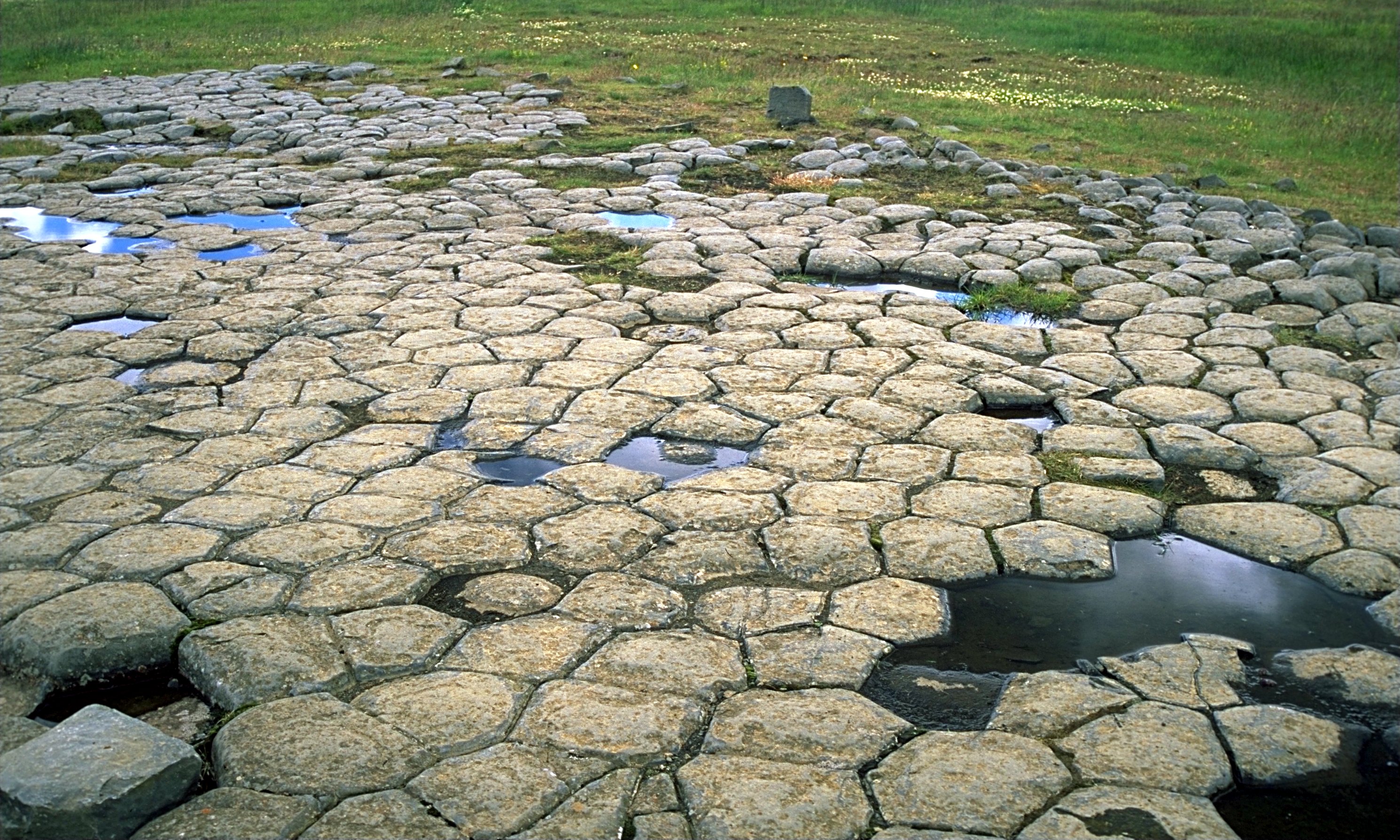
These first 6 pix were taken at Kirkjugólf-- literally "Church floor." But there never was a church or any other building here. When the settlers arrived, they saw it and assumed that this was the ruins of an old church. Looks like hex tiles, but it's actually the top of a clump of basalt columns. You would think I would include a photo. But I didn't. Didn't even take a very good one. But my kids look cute. Check out here for a good shot taken by some stranger.


Waterfall at Dverghamrar (Dwarf's Cliffs). There was one of these simple beauties every 500 yards.
Núpsstaður farm houses. In the south of Iceland, you see this old orange and red thing in every photo.


Not a good shot, but I thought I'd use it to show a point. That cliff is a sea cliff. It is also 25 km from the sea. Various eruptions have raised the level of the land with lava or glacial wash. Often we would drive through villages which used to be thriving fishing villages until the harbour filled with lava and the sea became unreachable. Few people die in Iceland due to the volcanoes, but often their lives are changed irrevocably as the earth and it's purpose changes around them.


This bridge is a fine example of man's tentative existence in Iceland. In 1996, there was a sub-glacial volcanic eruption underneath Vatnajökull, which rapidly melted the glacier, causing icebergs to rapidly break off and flow down the river, and crash into the bridge shown here. Many of these iceberg exceeded 100 tons in weight and these steel girders didn't stand a chance. Now, they've rebuilt the bridge, and this monument to that bit of morning activity made a great slide for the kids (ages 7 - 32).


The Black Falls


"Hof" is Icelandic for "temple" and so this was the Temple Church. It was just a pretty little church. All of the churches (and many of the old homes) are painted a pretty, vibrant cornflower blue inside. It was really lovely.
Here the glacier meets the water and icebergs calve off and float into the Atlantic. We had a boat tour around the lagoon.


Due to the massive thickness and weight of the glacier, the glacial ice is 5 times more dense than regular ice, so it has a higher melting point. This makes it perfect for drinks. By the time that it breaks off into the water, the ice has been making its journey for the past 1000 years. We were able to sample it, and it was very cold, very clean, and very tasty. I wish that I had brought a Coke. The black lines in the bergs aren't pollution but the sediment that the glacier drags along with it.


Part of our group, all booted up.
The lady on the boat informed us that there are often seals sunning themselves. Livia perked right up to this, and we searched and searched, but only saw this very seal-like iceberg. We were told to go and check near the beach, as sometimes there are seals there. Ariel, Tracey and the girls went ahead of me to check. As I was walking along to join them, I saw them coming back, looking forlorn. (Lena was actually screaming because the terns saw her as a threat and were dive-bombing her. That was funny.) So I waited for them to catch up and looked out over the lagoon. And what did I see?
For Livia, this made the whole trip worth it.

Had to Eat the Vegetarians - Part 6

Short one for today. Click for Part 1.
Here was Hekla mountain the next morning in all of her glory.
Livia found some vegetation.
Our bus. It doesn't look like much, but on this day, that puppy forded about 15 rivers.
This lake (labeled on the photo) was absolutely stunning. A real jolt of colour in the barren landscape. Gyða told us a legend about a group that was living nearby, ate some fish stew and died, and everyone assumed that the fish must have been poisonous. So we always referred to this as Poisoned Fish Lake. When I went to find the real name of the lake, it took me forever. Seems that no one else calls it that. I found it via Google Earth.
Behind me when I was taking the lake picture is this small, cratered hill.
Landmannalaugar was stunning. The picture looks ridiculous with all of the colours, but that's really how it looked. Plus, there was a lava field and a naturally hot stream. I wish I had taken more pictures.
Heading south.
This lovely stuff above is called Fountain Apple Moss, Philonotis fontana. It is such a refreshing sight on the bleak slag hills and marks where there is water.

Finally, grass and trees appeared about an hour before we arrived at our guest house.

Friday, 25 July 2008

Walking on the Moon - Part 5

Click here for Part 1.


This day we turned south and crossed the Icelandic Highlands, stopping first to see a famous waterfall, Goðafoss -- Falls of the (heathen) Gods. In 1000, the Assembly (which met in Thingvellir, from Part 1) was debating which religion should be the official state religion, as the existence of the two religions and two sets of religious laws was tearing the country up. The pagan priest and chieftain Þorgeirr Ljósvetningagoði (no, I'm not making up these names, and yes, you were be tested on this later) meditated on this for a day and a night under a fur, and came to the conclusion that Christianity was best, and to show his siding with the new religion, he went home and tossed all of his idols into this waterfall for dramatic effect.
Fooled, you. This isn't it.
And this ↑ is just the lower falls.
Can't you just picture the little wooden Odin tumbling over, his ravens flapping away to escape?

A plaque at the falls. "Oh, Lord, my God, how marvelous is thy name in all the earth." In my bible (KJV), that's Psalms 8:1, but here it's listed as Psalms 8:2. Many European bibles use the old verse number system where the choir directions given at the beginning of the Psalm are counted as verses themselves. As is the case here. Little bit of useless for you.

Aldeyjarfoss. Lovely falls in a lovely canyon. Best part are the basalt columns that look like a cathedral's pipe organ. It was bitterly cold here. As I was hiking down into the gorge, I met Lena coming back up at full speed. Ariel had released her to go sit in the bus, and she picked up her sister, and they scurried away, never seeing this beautiful sight.
Hofsjökull glacier.
The landscape was terribly bleak and quite lunar, so much so that the Apollo 11 astronauts Buzz Aldrin and Neil Armstrong practiced their moon buggy driving here. Also like the moon, it was bitterly cold. We stopped at the Nyidalur mountain hut for a potty break, and the temperature there was 6ºC, and below zero with the wind child. (The moon has the advantage of being windless.)


We stopped for the night at the only available guesthouse for 100 kilometers near the hydro-electric reservoir of Þórisvatn. When they built the dam, they built a set of barracks to house the workers nearby, and that has since been converted into a "guesthouse." I've stayed in nicer youth hostels (which is really saying something). Ironically, the place required that we all either remove our boots or cover them with little plastic booties to keep the place clean. I found this galling. However, it was our only option, and after plunking my stuff down in our room, I escaped into the countryside since there was no chance of it getting dark on me 2 degrees south of the Arctic Circle in July.
The landscape reminded my of the western deserts of the US, minus the tumble weed, add lava rocks. As we would see all over Iceland, the plant that worked the hardest to turn lava into soil was a type of very springy silvery moss (Racomitrium lanuginosum).


The most active volcano in Iceland: Hekla, hooded as she is named. ("hekla" is a short, hooded cloak.) She last erupted in 2000.